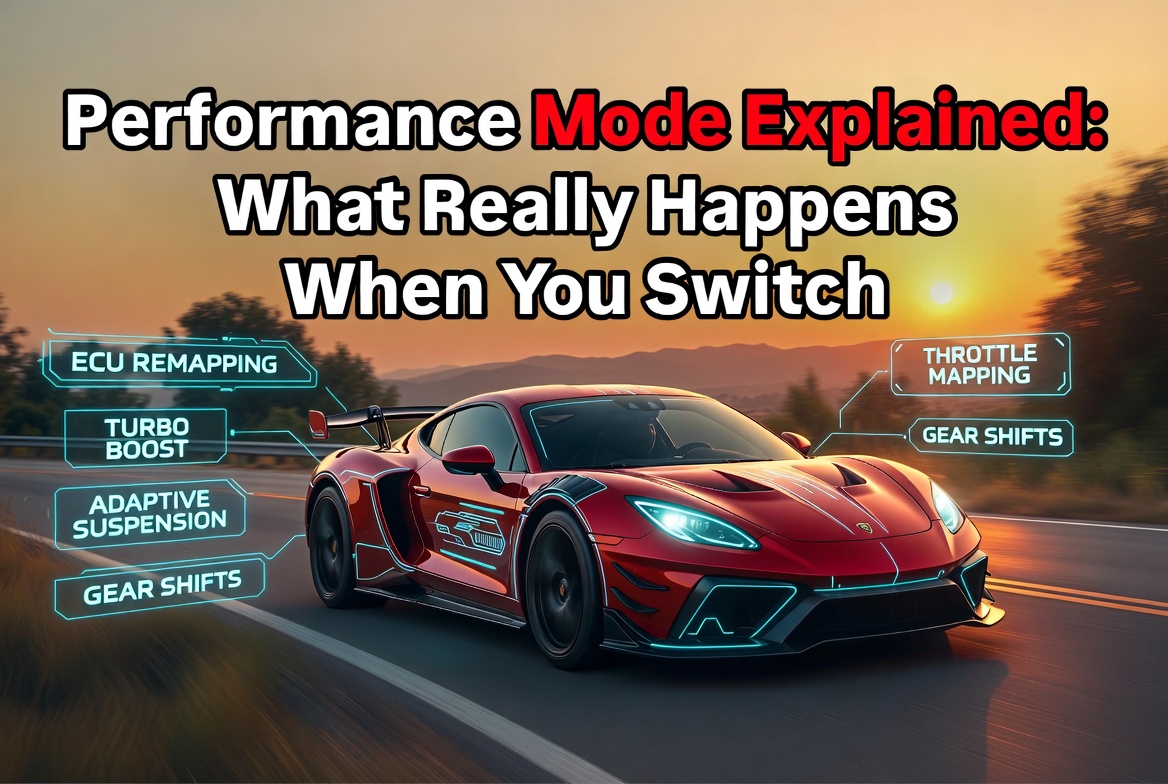
Modern cars are no longer just mechanical machines. Today’s vehicles are highly advanced computer-controlled systems that can instantly change their behavior with a simple press of a button. One of the most exciting features in modern vehicles is Performance Mode.
Performance mode is designed to unlock maximum power, sharper handling, and faster response from the car. But behind this simple driving option lies a complex combination of software, sensors, and mechanical systems working together in real time.
In this article, we will break down how new technology works in performance mode and what actually happens when you switch your car into this aggressive driving setting.
What Is Performance Mode?
Performance mode is a driving setting that changes how a car behaves by adjusting multiple systems at once. Instead of focusing on fuel efficiency or comfort, it prioritizes:
- Faster acceleration
- Sharper throttle response
- Higher RPM limits
- Stiffer suspension
- More aggressive gear shifting
- Enhanced steering feedback
This mode is commonly found in modern sports cars, SUVs, and even some economy vehicles with advanced driving systems.
1. ECU Remapping in Real Time
At the heart of performance mode is the Engine Control Unit (ECU). This is the car’s brain.
When performance mode is activated, the ECU instantly changes key engine settings:
- Increases throttle sensitivity
- Adjusts fuel injection timing
- Optimizes air-fuel ratio
- Raises RPM limits
- Reduces turbo lag
Instead of a slow and smooth power delivery, the ECU makes the engine respond immediately to driver input. Even a small press on the accelerator results in faster acceleration.
2. Turbocharger Boost Adjustment
In turbocharged vehicles, performance mode directly affects the turbo system.
Modern cars use electronic controls to manage boost pressure. When performance mode is turned on:
- Turbo boost pressure increases
- Wastegate opens later for more power
- Turbo spool becomes more aggressive
- Engine receives more compressed air
This results in significantly higher horsepower and torque output, especially at mid to high RPMs.
Some modern systems even use electric turbo assistance or hybrid turbo setups to eliminate lag completely.
3. Transmission Behavior Changes
One of the most noticeable effects of performance mode is how the transmission behaves.
Automatic and dual-clutch transmissions are controlled by software, which changes instantly in performance mode:
- Gear shifts happen faster
- Downshifts become more aggressive
- Higher RPMs are maintained before shifting
- Kickdown response becomes immediate
- Manual mode becomes more responsive
This ensures the engine stays in its optimal power band at all times.
4. Adaptive Suspension Technology
Many modern performance vehicles use adaptive or electronic suspension systems.
When performance mode is activated:
- Shock absorbers become stiffer
- Body roll is reduced
- Cornering stability improves
- Ride height may adjust automatically
- Suspension reacts faster to road conditions
Sensors continuously monitor road surface, steering input, and vehicle speed. The system adjusts damping in milliseconds to keep the car stable during aggressive driving.
5. Electronic Steering Response
Modern cars use electronic power steering (EPS) instead of traditional hydraulic systems.
In performance mode:
- Steering becomes heavier and more precise
- Steering ratio may change dynamically
- Road feedback increases
- Steering input response becomes faster
This gives the driver a more connected and controlled driving experience, especially at high speeds or during cornering.
6. Throttle Mapping and Drive-by-Wire Systems
In older cars, throttle input was mechanical. In modern vehicles, it is controlled electronically through a drive-by-wire system.
Performance mode changes throttle mapping:
- Less pedal movement gives more power
- Acceleration feels instant
- Delay between pedal and engine response is reduced
- Power delivery becomes aggressive instead of smooth
This is one of the biggest reasons performance mode feels “fast” even at lower speeds.
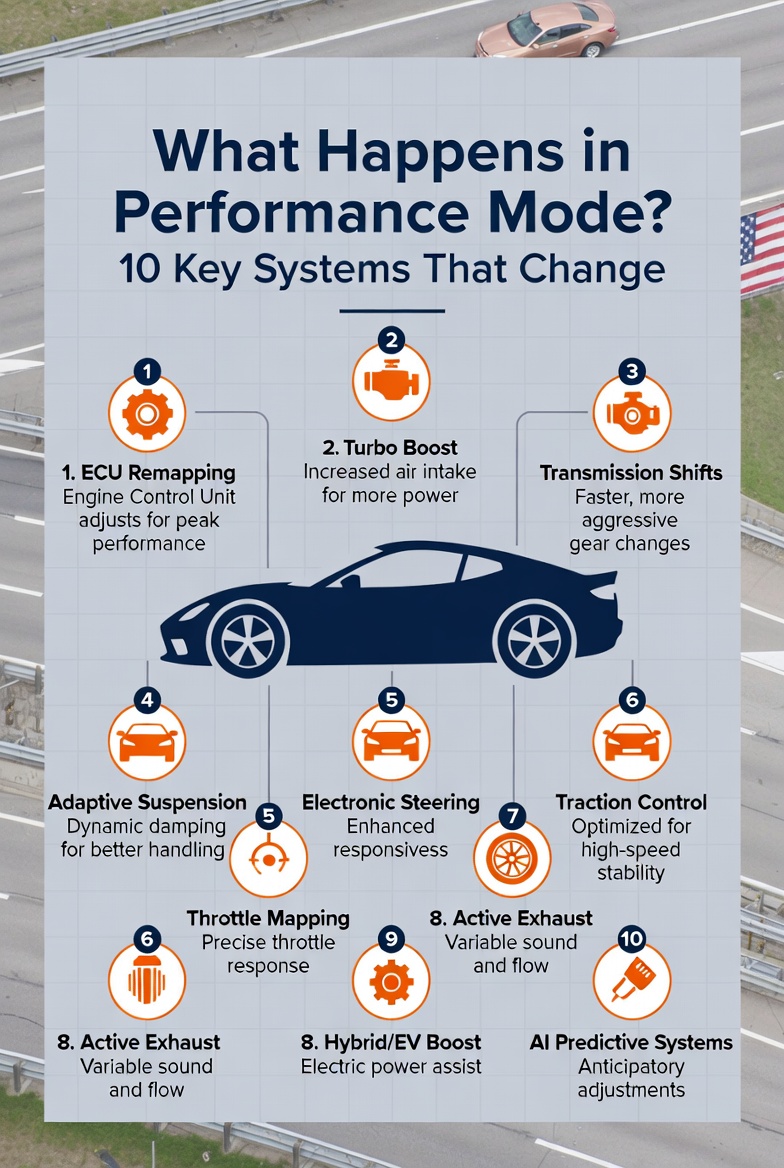
7. Traction and Stability Control Adjustments
Safety systems also change in performance mode.
Depending on the vehicle, the system may:
- Reduce traction control sensitivity
- Allow controlled wheel slip
- Relax stability control intervention
- Enable sport drift or track settings
This allows more freedom for sporty driving while still maintaining a safety net in the background.
Some high-performance cars even allow partial or full traction control disablement in track mode.
8. Exhaust and Sound Enhancement Systems
Modern performance cars often include active exhaust systems.
In performance mode:
- Exhaust valves open fully
- Engine sound becomes louder and deeper
- Backpressure is reduced for better flow
- Artificial sound enhancement may activate in cabin speakers
This improves both performance and driving experience by making the car feel more aggressive.
9. Hybrid and Electric Performance Boost
In hybrid and electric vehicles, performance mode works differently but even more instantly.
- Electric motors deliver instant torque
- Battery output increases for maximum power
- Dual motor systems engage all-wheel drive
- Regenerative braking adjusts for sport driving
- Thermal management systems activate cooling boost
Electric vehicles often show the biggest performance difference between normal and performance mode because there is no delay in power delivery.
10. AI and Predictive Driving Systems
The latest modern vehicles use AI-based systems to improve performance mode even further.
These systems analyze:
- Driving style
- Road conditions
- Steering patterns
- Acceleration behavior
Based on this data, the car can:
- Pre-adjust suspension before cornering
- Predict gear shifts
- Optimize power delivery before acceleration
- Improve traction in real time
This makes performance mode smarter, not just faster.
Conclusion
Performance mode in modern cars is not just a simple “speed boost” button. It is a fully integrated system that connects the engine, transmission, suspension, steering, and electronic controls into one synchronized performance network.
With technologies like ECU tuning, adaptive suspension, turbo management, and AI-driven optimization, today’s vehicles can completely transform their behavior within seconds.
As automotive technology continues to evolve, performance mode will become even more intelligent, offering drivers a perfect balance between speed, control, and safety.