
In the performance world, horsepower is often treated like a luxury that only comes with expensive builds and high-end upgrades. But that perception does not fully reflect reality, especially in the United States where the aftermarket industry offers a wide range of affordable modifications that can deliver real, measurable gains. The key is not how much you spend, but how intelligently you choose your upgrades.
What makes horsepower interesting is that it is not created by a single component. It is the result of how efficiently an engine can move air, mix fuel, and convert combustion into usable power. Most budget-friendly performance mods focus on improving these three areas rather than completely transforming the engine. This is why some relatively inexpensive upgrades can produce noticeable improvements in speed and responsiveness.
One of the most effective low-cost modifications is improving airflow into the engine. A performance air intake system is often the starting point for many enthusiasts because it directly addresses one of the biggest limitations in factory setups. Stock intake systems are designed to be quiet and cost-efficient, which often restricts airflow. By allowing cooler and denser air into the engine, a performance intake can improve combustion efficiency and add measurable horsepower. In many cases, gains fall between 5 and 20 horsepower, depending on the vehicle and setup.
While the numbers may seem modest, the real value of an intake upgrade becomes clearer when it is combined with other modifications. Horsepower gains are rarely isolated. They build on each other, and improving airflow is one of the foundational steps in unlocking more power from an engine.
Another highly effective upgrade within a reasonable budget is a performance exhaust system. Engines work like air pumps, and just as important as bringing air in is pushing exhaust gases out efficiently. Factory exhaust systems often create backpressure, limiting how quickly gases can exit the engine. A high-flow exhaust reduces this restriction, allowing the engine to operate more freely. This can result in gains typically ranging from 5 to 20 horsepower, with even higher improvements in turbocharged vehicles.
Beyond the raw numbers, an upgraded exhaust also changes how the car feels. The engine becomes more responsive, especially at higher RPMs, and the overall driving experience becomes more engaging. This is one of the reasons why exhaust systems remain one of the most popular performance upgrades in the United States.
If there is one modification that consistently delivers strong value for money, it is ECU tuning. Modern vehicles are controlled by software that manages fuel delivery, ignition timing, and overall engine behavior. Manufacturers often leave a margin of unused performance to ensure reliability and meet emissions standards. ECU tuning taps into that unused potential by optimizing these settings. The results can be significant, with gains ranging from 10 to 50 horsepower on naturally aspirated engines and even higher on turbocharged setups.
What makes tuning particularly powerful is that it enhances the effectiveness of other modifications. An intake or exhaust upgrade alone may provide small gains, but when combined with proper tuning, those gains become more pronounced and consistent. In many ways, tuning acts as the bridge that connects all performance upgrades into a cohesive system.
Fuel delivery is another area that plays a subtle but important role in horsepower. While upgrading fuel injectors may not directly add power on their own, they support higher performance levels when combined with other mods. As airflow increases, the engine requires more fuel to maintain the correct air-fuel ratio. Without proper fuel delivery, the engine cannot fully utilize the benefits of other upgrades. This is why fuel system improvements are often considered a supporting modification rather than a standalone upgrade.
Another overlooked aspect of increasing horsepower is reducing restrictions within the engine system. Components like throttle bodies, intake manifolds, and headers can all influence how efficiently air moves through the engine. While these upgrades may not always produce dramatic gains individually, they contribute to an overall improvement in engine efficiency. When combined with intake, exhaust, and tuning upgrades, they help create a more balanced and powerful setup.
It is also important to recognize the difference between naturally aspirated engines and turbocharged engines when discussing budget performance mods. Naturally aspirated engines typically see smaller gains from basic upgrades because they rely solely on atmospheric pressure for airflow. In contrast, turbocharged engines respond much more aggressively to modifications. Even simple upgrades like an exhaust system and tuning can result in significantly larger horsepower increases because they enhance the efficiency of the turbo system.
This difference is one of the reasons why turbocharged cars have become increasingly popular in the United States. They offer more flexibility in terms of performance upgrades and often deliver better returns on investment when it comes to horsepower gains.
The idea of “not breaking the bank” is also tied to how these modifications are approached. Instead of spending a large amount on a single upgrade, many enthusiasts choose to build performance gradually. This approach allows for better budget management while also ensuring that each modification complements the others. A well-planned combination of intake, exhaust, and tuning can often deliver better results than a single expensive upgrade that is not supported by other changes.
Another factor that contributes to affordability is accessibility. The US aftermarket industry is highly developed, offering a wide range of parts at different price points. This competition makes it possible to find quality components without overspending. However, it also means that not all products deliver the same level of performance. Choosing reputable brands and understanding how each modification works is essential to getting the best value.
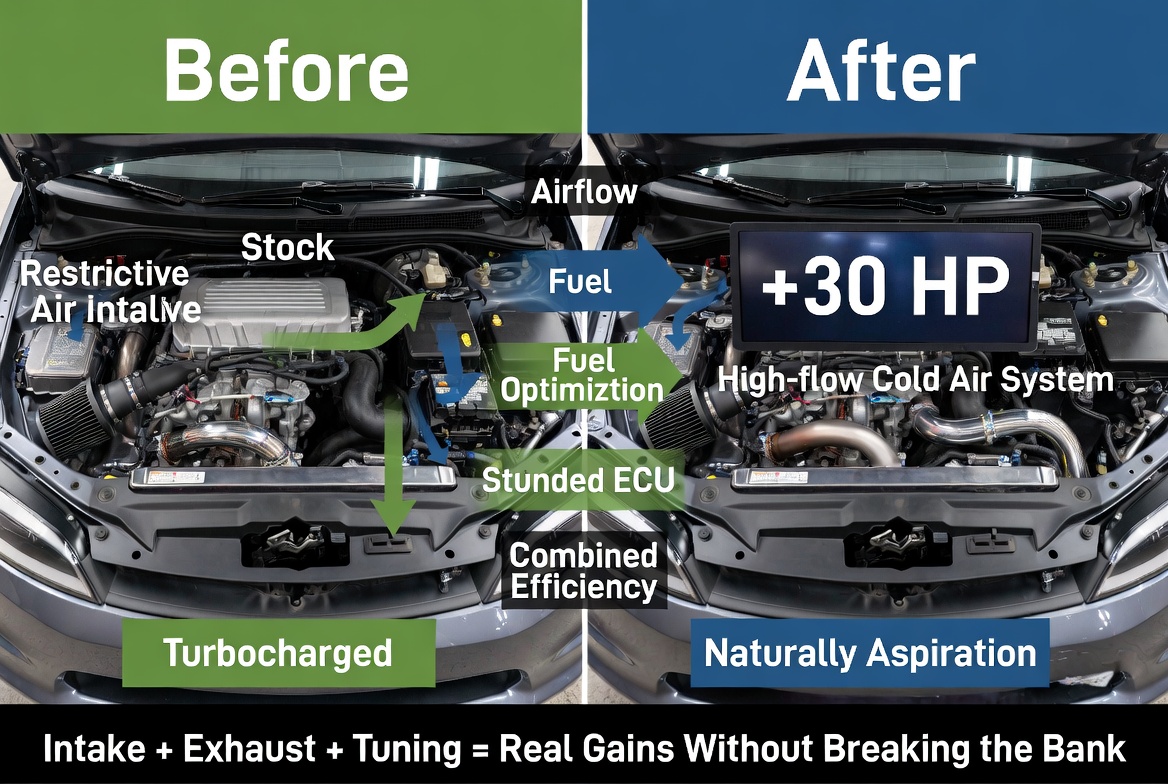
It is worth noting that not every performance mod labeled as “high horsepower” actually delivers meaningful results. Some upgrades are more focused on aesthetics or sound rather than real performance. This is why understanding the fundamentals of how engines produce power is so important. Horsepower is not about adding random parts. It is about improving airflow, optimizing fuel delivery, and ensuring that all components work together efficiently.
There is also a psychological element to performance upgrades. Even small increases in horsepower can make a car feel significantly faster, especially when combined with improved throttle response and sound. This is why budget-friendly mods are so appealing. They offer a noticeable improvement in driving experience without requiring a major financial commitment.
In the end, increasing horsepower without breaking the bank is entirely possible, but it requires a strategic approach. The most effective mods are not always the most expensive ones. They are the ones that improve the engine’s efficiency and work together as part of a complete system.
Performance air intakes, high-flow exhaust systems, and ECU tuning consistently stand out as some of the best value upgrades in the United States. When combined with supporting modifications and proper planning, they can transform how a car performs without pushing costs into extreme territory.
For most car enthusiasts, the goal is not just maximum horsepower, but smart horsepower. It is about getting the most performance out of every dollar spent. And when done right, budget performance mods prove that you do not need a massive investment to feel a real difference every time you press the accelerator.