
Car culture in the United States has always been closely tied to performance. From muscle cars roaring down highways to modern turbocharged imports, drivers are constantly looking for ways to push their vehicles beyond factory limits. Performance modifications are at the center of this passion, but one question comes up again and again: how much do these upgrades actually cost in the USA?
The answer is not simple because performance modifications are not a single purchase. They exist on a spectrum, ranging from small affordable upgrades to complete engine transformations that can cost more than the car itself. What makes this topic interesting is not just the price, but the intention behind the spending. For some, it is about speed. For others, it is about sound, control, or simply the satisfaction of building something unique.
In the United States, the cost of performance mods is heavily influenced by labor rates, brand quality, location, and the type of vehicle being modified. A simple modification in one state might cost significantly more in another due to labor costs and regulations. This is why understanding the financial side of performance upgrades is essential before diving into the modification world.
At the entry level, many car owners start with basic performance upgrades that are relatively affordable. These include cold air intakes, performance air filters, and exhaust modifications. A cold air intake system typically ranges between 200 and 600 dollars depending on the brand and vehicle compatibility. While this may not seem like a huge investment, it often provides a noticeable improvement in engine breathing and throttle response. Similarly, aftermarket exhaust systems can cost anywhere from 300 to 1500 dollars. The price variation comes down to material quality, sound design, and whether the system is cat-back or axle-back.
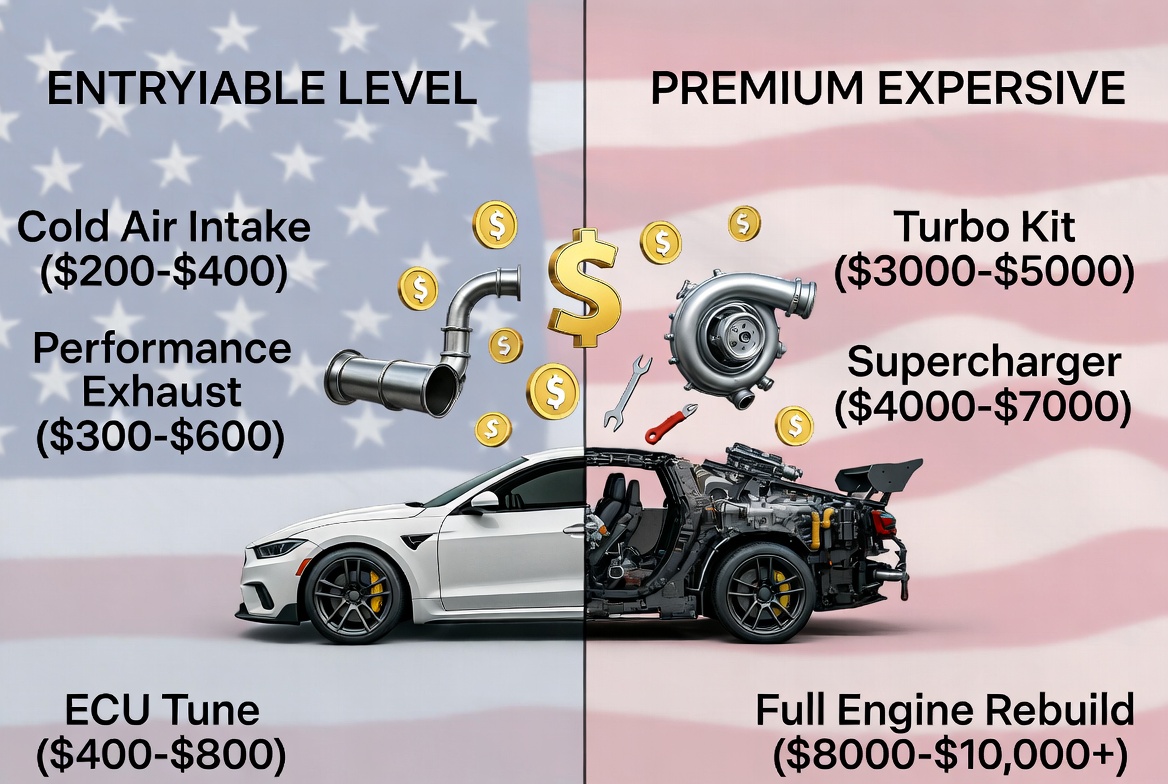
As enthusiasts move further into performance tuning, the costs begin to rise more noticeably. One of the most popular upgrades in the United States is ECU tuning. This involves reprogramming the car’s engine control unit to optimize fuel delivery, ignition timing, and boost pressure. A basic ECU tune can cost around 300 to 800 dollars, but more advanced custom tuning sessions can exceed 1500 dollars, especially when dyno testing is involved. Dyno tuning itself is a separate expense, often costing between 100 and 200 dollars per hour, and is commonly used to maximize performance safely.
For those seeking significant power gains, forced induction modifications such as turbochargers and superchargers become attractive options. However, this is where costs can escalate quickly. A turbocharger kit in the United States typically ranges from 2000 to 5000 dollars, depending on the complexity and quality of components. Installation costs can add another 1000 to 3000 dollars, especially if custom fabrication is required. Supercharger kits often fall within a similar price range but may have different installation requirements depending on the vehicle.
The financial commitment becomes even more serious when internal engine modifications are considered. Upgrading pistons, camshafts, crankshafts, and other internal components is not just expensive in terms of parts, but also labor. Engine rebuilds focused on performance can easily cost between 4000 and 10000 dollars in the United States. These types of builds are usually pursued by serious enthusiasts or racers who are looking for maximum horsepower and reliability under extreme conditions.
Another important factor that affects the overall cost of performance mods is labor. In the United States, labor rates vary widely depending on the region. In major cities like Los Angeles or New York, hourly labor rates can range from 120 to 200 dollars. In smaller towns or less expensive states, rates may be closer to 70 to 100 dollars per hour. This means the same modification can have a drastically different total cost depending on where it is installed.
Beyond the direct cost of parts and labor, there are hidden financial impacts that many car owners overlook. One of the biggest is insurance. Modifying a car for performance can lead to higher insurance premiums in the United States. Insurance companies may consider modified vehicles as higher risk due to increased speed potential and the possibility of aggressive driving. In some cases, certain modifications must be declared, and failure to do so could result in denied claims.
Fuel consumption is another ongoing cost that comes with performance upgrades. Many modifications, especially those that increase horsepower, also increase fuel usage. High-performance engines often require premium gasoline, which is more expensive than regular fuel. Over time, this adds a noticeable amount to the total cost of owning a modified car.
Legal considerations also play a role in the financial aspect of performance mods. In the United States, emissions regulations vary by state, and certain modifications may not be street legal. California, for example, has strict emissions laws that can limit the types of performance upgrades allowed. Failing to comply with these regulations can result in fines or the need to revert the car back to stock condition, adding further costs.
Despite all these expenses, performance modifications continue to grow in popularity. This is because the value is not purely financial. For many car enthusiasts, modifying a vehicle is a personal journey. It is about creativity, control, and the thrill of driving something that feels uniquely theirs. The cost becomes part of the experience rather than just a number.
It is also worth noting that not all performance mods deliver equal value. Some upgrades provide noticeable improvements for relatively low cost, while others offer minimal gains despite a high price tag. This is why research and planning are essential. Understanding what each modification does and how it aligns with your goals can prevent unnecessary spending and maximize results.
In the United States market, there is a strong ecosystem supporting performance modifications. From aftermarket brands to specialized tuning shops, there are countless options available. This competition helps keep prices competitive but also creates a wide range of quality levels. Choosing reputable brands and experienced installers may cost more upfront, but it often saves money in the long run by avoiding failures and rework.
When looking at the bigger picture, the cost of performance mods in the USA can range from a few hundred dollars to tens of thousands. A simple setup with basic upgrades might stay under 2000 dollars, while a fully built performance car can easily exceed 20000 dollars. The final number depends entirely on the vision of the owner and the level of performance they are trying to achieve.
In the end, performance modifications are not just about spending money. They are about making deliberate choices. Each upgrade adds a layer to the car’s personality, shaping how it drives, sounds, and feels. Understanding the cost is important, but understanding the purpose behind those costs is what truly defines a successful build.
For anyone entering the world of car modification in the United States, the key is balance. Spend where it matters, plan ahead, and always consider the long-term impact. Performance mods can be expensive, but when done right, they offer an experience that goes far beyond the price tag.